



As part of the WISE (Women in Solidarity for Energy), LIGHT (Local Initiatives for Green Housing Transitions), and OTKA - Hungary in the Energy Crisis projects, Sára Szabó, Ana Stojilovska, and Lili Szücs from the Institute for Political Science organized on 12 May 2026 the conference “The Female Faces of Poverty – Challenges, Services, Vulnerable Groups” at the MTA Humanities Research House in Budapest. The conference examined the social impacts of the energy crisis and the various dimensions of energy justice, and shed light on the phenomenon of women’s poverty and the gender dimensions of poverty in a multifaceted way. The multi-panel brought together researchers, social workers, activists, and community organizers through project presentations, thematic panels, and a final practitioner roundtable.
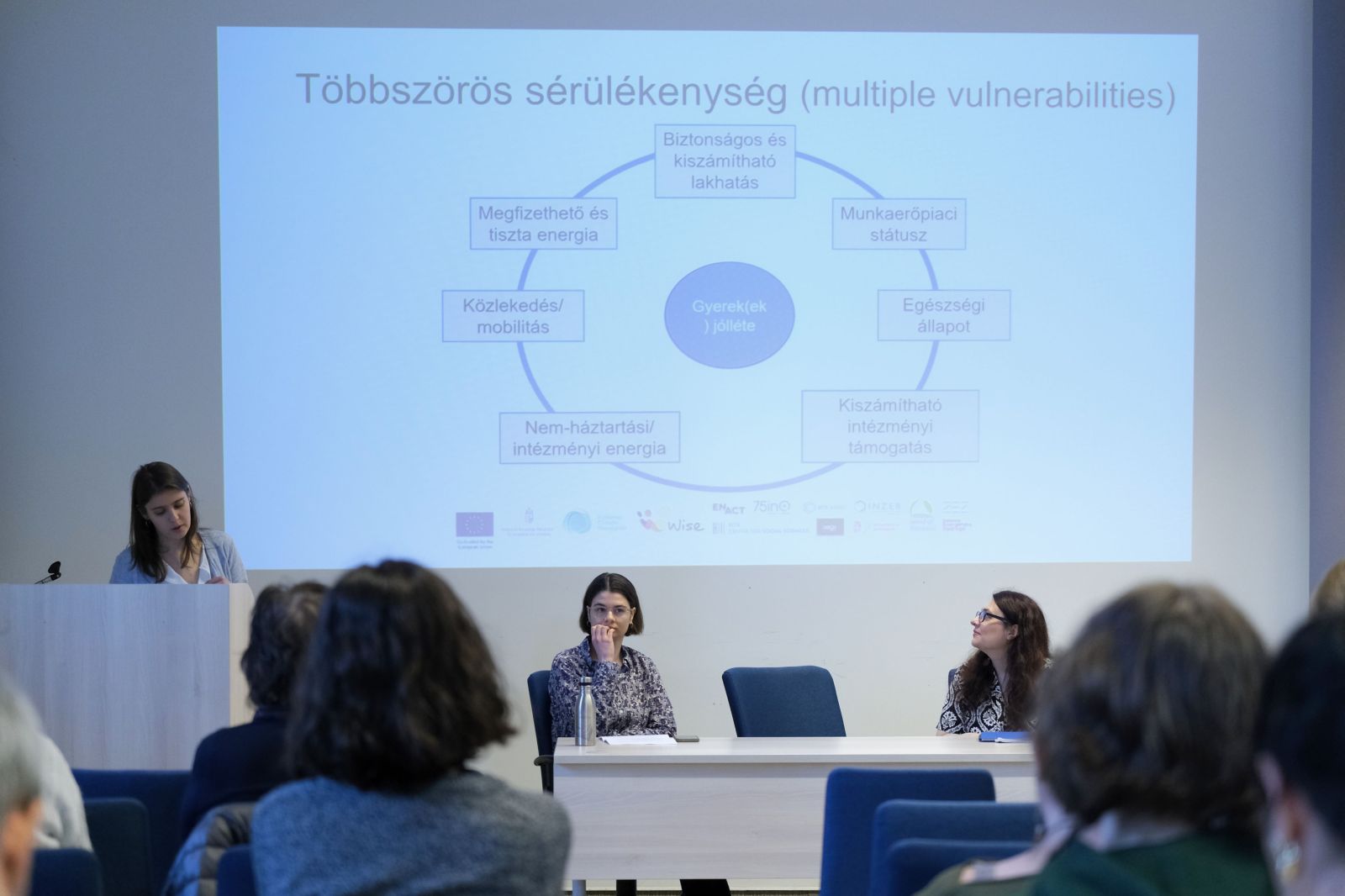
The program focused strongly on energy poverty and gendered vulnerability, including the effects of the 2022 energy crisis in homes, workplaces, public institutions, services, and public transport; single mothers’ experiences of cold homes, insecure housing, transport barriers, and everyday financial “juggling”; and the role of gender inequalities in exposure to energy poverty. The project team presented the Trust to Transition toolkit, which highlighted low-cost, low-carbon support measures, including thermal comfort interventions for vulnerable groups, and emphasized that energy vulnerability is linked to housing quality, income insecurity, care responsibilities, and access to services.
Other panels addressed poverty data problems, transport poverty, family policy and single motherhood, violence against women, prostitution, migration, care work, homelessness, Roma women’s situation, reproductive access, and Ukrainian refugee women’s experiences. A key conclusion was that women’s poverty is produced by intersecting structural barriers and therefore requires coordinated policy responses, expanded support systems, and stronger participation of affected women. The conference was financially supported by the European Union (CERV program), the European Climate Foundation, and the National Research, Development, and Innovation Office, Hungary.
Photo credit: Rebeka Murvay